
Moto G67 Power 5G vs Redmi 15 5G
On this page you can compare Moto G67 Power 5G and Redmi 15 5G side by side. Looking at Moto G67 Power 5G vs Redmi 15 5G helps you quickly spot the differences in specs and features, so you can decide which one is the better fit for you. The best price currently available for Moto G67 Power 5G is ₹16,999 and for Redmi 15 5G is ₹16,499. last updated on Mar 17, 2026.

Moto G67 Power 5G vs Redmi 15 5G Specifications
| Specification | ||
|---|---|---|
| General | ||
| In The Box | Handset, 33W charger, USB Type-C cable, SIM ejector tool, documentation | Mobile Phone, 33W Charger, USB Type-C Cable, SIM Eject Tool, Quick Start Guide, Warranty Card, Safety Information |
| Model Name | Moto G67 Power 5G | Redmi 15 5G |
| Launch Date | 05/11/2025 | 01/08/2025 |
| Colors | Pantone Parachute Purple, Pantone Blue Curacao, Pantone Cilantro | Midnight Black, Sandy Purple, Frosted White |
| Brand | Motorola | Redmi |
| OTG Support | Yes | Yes |
| Display | ||
| Display Size | 6.7, 17.02 | 6.9, 17.5 |
| Resolution | 1080, 2400 pixels | 1080, 2340 pixels |
| Resolution Type | Full HD+ | FHD+ (Full HD Plus) - 1080 x 2340 pixels, 19.5:9 aspect ratio |
| Refresh Rate | 120 Hz | 144Hz Adaptive Sync with 288Hz Touch Sampling Rate |
| Display Type | LCD (IPS) with Gorilla Glass 7i protection | IPS LCD with Excellent Brightness and Color Accuracy |
| Display Design | Flat display (no curved edges) | Punch Hole Display with ~85.7% Screen-to-Body Ratio |
| Brightness | High Brightness Mode up to 1050 nits | 850 nits (peak), 700 nits (HBM), 600 nits (typical) |
| Screen Protection | Corning Gorilla Glass Victus 7i | Corning Gorilla Glass 3 (Mohs level 6), TÜV Rheinland Certified (Flicker-Free, Low Blue Light, Circadian Friendly) |
| Body | ||
| Dimensions | 166.23 × 76.50 × 8.60 mm | 169.5 x 80.5 x 8.4 mm (6.67 x 3.17 x 0.33 inches) |
| Weight | 210 g | 217 grams (7.65 oz) |
| Build Material | Front glass (Gorilla Glass 7i) and vegan-leather back (aluminum/alloy frame) | Glass front (Gorilla Glass 3), Plastic frame, Plastic back with Aerospace-Grade Metal Camera Trim |
| Ports | USB Type-C 2.0 port; 3.5 mm headphone jack | USB Type-C 2.0 with OTG Support, No 3.5mm Headphone Jack |
| IP Rating | IP64 (dust and splash resistant) | IP64 - Dust Tight and Water Resistant to Splashes |
| Stereo Speakers | Stereo speakers (Dolby Atmos support) | Single Bottom-Firing Loudspeaker with Dolby Certification |
| Audio Features | 3.5mm Audio Jack, Hi-Res Audio Certification, Dolby Atmos, Dolby Digital, Spatial Audio, Dual Mics with Noise Cancellation | Hi-Res Audio Certification, Advanced Bluetooth Codecs, aptX, LDAC, Dolby Atmos, Ultra Volume Mode |
| Processor | ||
| Operating System | Android 15 (Hello UX) | Android 15 with HyperOS 2.2 Customization |
| Chipset Brand & Model | Qualcomm Snapdragon 7s Gen 2 (4 nm) | Qualcomm Snapdragon 6s Gen 3 |
| CPU Type | Octa-core Kryo CPU (4×2.4 GHz Cortex-A78 + 4×1.95 GHz Cortex-A55) | Octa-core (2x Cortex-A78 @ 2.3GHz + 6x Cortex-A55 @ 2.0GHz) |
| Core Count | Octa-core | Octa-core Configuration - 2 Performance + 6 Efficiency Cores |
| Clock Speed | 4×2.4 GHz Cortex-A78 + 4×1.95 GHz Cortex-A55 | 2.3GHz (Performance Cores), 2.0GHz (Efficiency Cores) |
| GPU | Adreno 710 GPU | Adreno 619 |
| Camera | ||
| Rear Camera Setup | 50 MP, f/1.8 (Sony LYTIA600 sensor, 0.8µm pixel, Quad Pixel 2.0, PDAF) 8 MP, f/2.2 (ultra-wide, 118° view) |
Dual Camera System with AI Enhancement - 50MP Main + Auxiliary Depth Sensor |
| Front Camera | 32 MP, f/2.2 (Quad Pixel 2.0, 0.7µm) | Single 8MP Front Camera with Screen Flash - Punch Hole Configuration |
| Flash Type | Dual LED flash | LED Flash for Rear Camera, Screen Fill Light for Front Camera |
| Zoom Features | 8× high-res digital zoom | Up to 10x Digital Zoom, No Optical Zoom |
| Video Recording | Rear main camera: 4K UHD @30fps, FHD @60fps Front: UHD/FHD @30fps All cameras support 4K recording |
1080p FHD Video at 30fps for Both Cameras |
| Battery | ||
| Capacity | 7000 mAh | 7000 mAh |
| Fast Charging Support | 30W wired (TurboPower) | 33W Wired Fast Charging with PD 2.0, PPS, and QC3 Compatibility |
| Wireless Charging | No | Not Supported |
| Reverse Charging | Not supported | 18W Reverse Charging to Power Other Devices |
| Memory & Storage | ||
| RAM | 8 GB | 4 GB, 6 GB, 8 GB |
| RAM Type | LPDDR4X | LPDDR4X |
| Internal Storage | 128 GB, 256 GB | 128 GB, 256 GB |
| Expandable Storage | None (no microSD slot) | Yes - microSDXC Card Support up to 1TB (Hybrid Slot) |
| Memory Card Type | Not Supported | microSDXC |
| Storage Type | UFS 2.2 | UFS 2.2 |
| Network | ||
| SIM Configuration | Dual SIM (Nano-SIM + Nano-SIM) | Dual Nano-SIM with Hybrid Slot (SIM1 + SIM2 or SIM1 + microSD) |
| SIM Type | Nano SIM | Nano SIM |
| Supported Network Bands | 5G bands n1/n2/n3/n5/n8/n28/n38/n40/n41/n77/n78 4G LTE bands 1/2/3/5/8/28/38/40/41/42 3G 1/2/5/8; 2G 2/3/5/8 |
2G: GSM 850/900/1800/1900 | 3G: HSDPA 800/850/900/1700(AWS)/1900/2100 | 4G: Bands 1,2,3,4,5,7,8,12,13,17,18,19,20,26,28,32,38,40,41,42,48,66,71 | 5G: SA n1/n3/n5/n8/n28/n40/n78, NSA n1/n3/n40/n78/n8 |
| 5G/4G/3G Support | 5G (sub-6 GHz), 4G LTE, 3G WCDMA, 2G GSM | Comprehensive 2G/3G/4G LTE/5G Support with Full Band Coverage for India |
| VoLTE/VoNR | Yes (4G VoLTE and 5G VoNR supported) | VoLTE (Voice over LTE) Enabled |
| Connectivity | ||
| Wi-Fi | Wi-Fi 5 (802.11 a/b/g/n/ac) dual-band (2.4 & 5 GHz) | Wi-Fi 5 (802.11ac) Dual-Band with Wi-Fi Direct and Hotspot |
| Bluetooth | v5.1 | Bluetooth 5.1 with A2DP, LE, and aptX Codec Support |
| NFC | No | Yes |
| USB Type | USB Type-C 2.0 | USB Type-C 2.0 |
| GPS/Navigation | Yes (GPS, GLONASS, Galileo, QZSS, BeiDou) | Quad-Band GNSS: GPS, GLONASS, GALILEO, BDS for Accurate Positioning |
| Internet Connectivity | 5G, 4G LTE, 3G, 2G, Wi-Fi | 5G, 4G LTE, 3G, 2G, Wi-Fi, Hotspot, USB Tethering, Bluetooth Tethering |
| WLAN Hotspot | Yes | Yes |
| FM Radio | No | No |
| Features | ||
| Sensors | proximity, ambient light, accelerometer, gyroscope, e-compass, SAR sensor | Comprehensive Sensor Suite for Gaming, Navigation, and Health Monitoring |
| Fingerprint Scanner | Side-mounted | Side-mounted |
| Face Unlock | Yes (via front camera) | 2D Face Unlock Using Front Camera |
| Special Features | MIL-STD-810H durability, AI assistant (Google Gemini), Dolby Atmos & Hi-Res Audio support, Pantone-validated color gamut, “Water Touch” technology for wet handling. | IR Blaster for Device Control, Hydro Touch for Wet Screen Responsiveness, AI Features (Circle to Search, Gemini AI, AI Erase), Virtual RAM Expansion up to 16GB |
Detailed Review
In This Comparison
Quick Verdict
Introduction
You’re out at 3 PM, your phone is at 11%, and you’re nowhere near a charger. Sound familiar? That’s the everyday reality for most Indian smartphone users — and it’s exactly why big-battery phones have become so popular. Two phones fighting for your attention right now in the under-₹17,000 space are the Moto G67 Power 5G and the Redmi 15 5G.
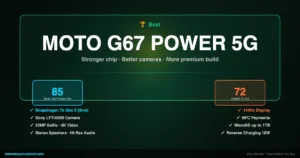
Both phones carry a massive 7,000mAh battery, both run on 5G, and both are priced close enough to make the decision genuinely hard. But they’re very different under the hood. Motorola brings a more powerful Snapdragon 7s Gen 2 chip, a premium vegan leather build, stereo speakers with Dolby Atmos, and a 3.5mm headphone jack. Redmi fights back with a bigger 6.9-inch 144Hz display, NFC for tap-to-pay, an IR blaster, expandable storage, and a slightly lower starting price.
In this article, you’ll get a clear, honest breakdown of every important spec — design, display, camera, performance, battery, software, and more — so you can spend your money wisely.
Design and Build
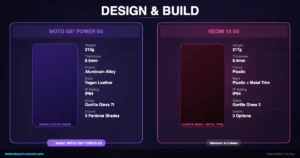 The first thing you notice with the Moto G67 Power 5G is how premium it feels for the price. It has a vegan leather back with Pantone-validated colours — Cilantro Green, Parachute Purple, and Blue Curacao. That textured leather back is grippy, resists fingerprints, and genuinely looks more expensive than it is. The frame is aluminium alloy and the front is protected by Corning Gorilla Glass 7i, which is a noticeably tougher glass than the Gorilla Glass 3 on the Redmi 15.
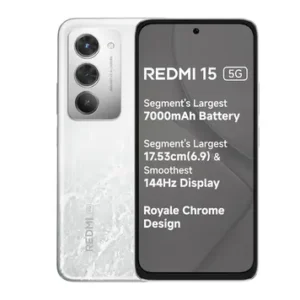
The Redmi 15 5G has a plastic frame and plastic back. The Frosted White variant has a nice marble-like texture and looks clean, but once you hold both phones together, the Moto clearly feels more solid. The Redmi does have a metal camera trim that adds a subtle touch of class, but the overall build is in a lower tier.
Both phones have an IP64 rating — they can handle dust and water splashes without a problem. The Moto G67 Power also carries MIL-STD-810H military-grade durability certification, making it more reliable for drops and tough conditions. The Moto weighs 210g and the Redmi is slightly heavier at 217g. Both are noticeable in the hand but comfortable enough for all-day use.
Display
This is where the Redmi 15 5G makes its strongest argument. It has a 6.9-inch FHD+ IPS LCD with a 144Hz refresh rate — higher than the Moto’s 120Hz. That extra smoothness shows when you’re scrolling through Instagram or playing a fast-paced game. The bigger screen also makes watching YouTube or reading ebooks noticeably more enjoyable. If screen size and refresh rate matter most to you, Redmi wins here.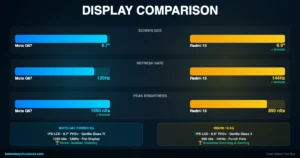
The Moto G67 Power has a 6.7-inch FHD+ IPS LCD at 120Hz with Gorilla Glass 7i protection. Its peak brightness goes up to 1,050 nits — meaningfully higher than the Redmi’s 850 nit peak. In practice, this means the Moto is easier to read outdoors under bright Indian sunlight, whether you’re standing at a bus stop or working out in a park.
Both are IPS LCD panels, so neither has the deep blacks or punchy colours of an AMOLED display — that’s a compromise you accept with both phones at this price. Neither has an Always-On Display, which is typical for LCD screens. For everyday indoor use, both look great. For outdoor readability, the Moto has a clear edge. Redmi 15 5G for size and smoothness, Moto G67 Power for outdoor brightness — it’s a tie depending on your use case.
Performance
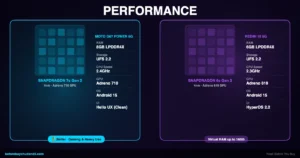
This is where the gap between these two phones becomes clear. The Moto G67 Power 5G runs on the Snapdragon 7s Gen 2 — a 4nm chip that punches well above its price bracket. It handles heavy multitasking, runs demanding games like BGMI and Call of Duty Mobile comfortably, and doesn’t heat up under pressure. Real-world use is very smooth. It comes with 8GB LPDDR4X RAM across all variants, so you’ll almost never feel the phone struggling. The Adreno 710 GPU is also a strong performer for graphics-heavy tasks.
The Redmi 15 5G uses the Snapdragon 6s Gen 3. It’s a capable chip for regular daily tasks — browsing, YouTube, WhatsApp, UPI payments — but it doesn’t have the raw power of the 7s Gen 2. The Adreno 619 GPU is noticeably weaker when it comes to gaming. At ₹16,499, you get 6GB RAM in the base variant (though 8GB options are also available at a higher price). The Redmi does have a virtual RAM expansion feature that lets you borrow from storage to extend RAM up to 16GB on paper, but in practice, virtual RAM isn’t a true replacement for physical RAM.
Both phones run Android 15. The Moto comes with a clean, near-stock experience via Hello UX — very minimal bloatware and useful Moto gestures. The Redmi runs HyperOS 2.2, which is feature-rich but comes with more pre-installed apps. If you like a clean Android experience, Moto wins here too.
For performance, the Moto G67 Power 5G is the stronger choice — especially if you game or multitask heavily.
Camera
The camera is honestly one of the biggest reasons to choose the Moto G67 Power 5G. Its primary rear camera is a 50MP Sony LYTIA600 sensor with an f/1.8 aperture and PDAF. Sony’s LYTIA sensors are well-regarded for good light capture and natural colour reproduction. In daylight, you get crisp, detailed photos with accurate colours. In low light, the Night Mode handles noise reasonably well — there’s still some softness in deep shadows, but for this price, it’s genuinely impressive.
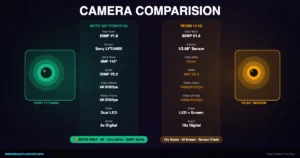
What makes the Moto’s camera setup more practical is the second lens — an 8MP ultra-wide camera with a 118-degree field of view. This is a proper second camera, not just a depth sensor for portraits. You can actually use it for group photos, architecture shots, or landscapes. The Moto also shoots 4K video at 30fps from both the rear and front cameras — something that’s rare at this price. The 32MP selfie camera with Quad Pixel 2.0 technology produces excellent selfies, and if you post reels or use video calls often, you’ll really appreciate it.
The Redmi 15 5G has a 50MP main camera (f/1.8 aperture) but no Sony sensor branding — it’s a 1/2.88-inch sensor with smaller 0.61μm pixels, which means it captures less light compared to the Moto in identical conditions. There’s no ultra-wide camera. The second camera is just an auxiliary depth sensor — it helps with portrait blur but isn’t an independent shooter. The selfie camera is only 8MP, which is noticeably weaker than the Moto’s 32MP front shooter. Video recording maxes out at 1080p 30fps on both cameras, with no 4K support at all.
If photos and videos matter to you — especially selfies or short videos for Instagram and YouTube — the Moto G67 Power 5G wins this category by a clear margin.
Battery and Charging
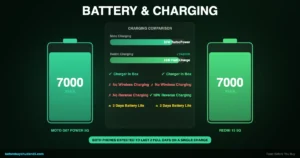
Both phones pack the same 7000mAh battery, which is a genuinely large capacity. In real life, expect comfortably two full days of use with moderate usage on either phone — calls, messaging, some social media, and a bit of YouTube. Heavy users who game, stream, and keep mobile data on all day should still get through a full day without any anxiety.
The difference lies in charging speed. The Moto G67 Power 5G charges at 30W TurboPower, and Motorola includes the charger in the box. The Redmi 15 5G charges at 33W — slightly faster, and also includes a 33W charger in the box. The difference between 30W and 33W in real use is very small, maybe 10-15 minutes for a full charge, so it’s not a deciding factor.
What the Redmi 15 5G has that the Moto doesn’t is 18W reverse charging. This means you can use the Redmi as a power bank to charge your earbuds, smartwatch, or a friend’s phone in a pinch. It’s a genuinely useful feature, especially on trips. Neither phone supports wireless charging.
For raw battery endurance, both are equal. For the bonus reverse charging ability, the Redmi gets a small edge. But since both come with chargers in the box, you’re all set on day one with either phone.
Connectivity
Both phones support 5G with Indian bands including n28, n40, n78, and n41 on the Moto — covering all major Indian 5G operators. The Redmi also covers the key Indian 5G bands. Both have Wi-Fi 5 dual-band, Bluetooth 5.1, GPS, OTG support, and a USB Type-C port.
Here’s where they differ: The Redmi 15 5G has NFC, which means you can tap to pay at any NFC-enabled payment terminal. While UPI via QR code is more common in India, NFC contactless payments are slowly growing in malls and retail stores. The Moto G67 Power 5G does NOT have NFC — a real miss at this price point in 2026.
The Moto G67 Power 5G has a 3.5mm headphone jack, which the Redmi 15 5G lacks. If you use wired earphones daily, this matters a lot. The Redmi also has an IR blaster — handy for controlling your TV or AC — which the Moto doesn’t have.
So: Redmi wins on NFC and IR blaster. Moto wins on the headphone jack. Pick based on what you’ll use more.
Price and Value
The Moto G67 Power 5G is priced at ₹16,999 on Flipkart for the 8GB + 128GB variant as of now. A 256GB variant is also available if you need more storage. Since there’s no microSD slot, you’ll want to think carefully about which storage option suits you.
The Redmi 15 5G starts lower — you can find it for around ₹16,499 on Amazon and the Mi website for the base 6GB + 128GB version, and ₹16,599 on Flipkart as of now. There are also 4GB and 8GB RAM options available. The Redmi has a hybrid microSD slot, meaning you can expand storage by up to 1TB — though you’ll have to sacrifice one SIM slot to do so.
Looking purely at what you get for the money, the Moto G67 Power 5G offers better value if you care about performance, cameras, and build quality — and 8GB RAM is guaranteed across all variants. The Redmi 15 5G is the smarter buy if you need NFC, expandable storage, or are working with a tighter budget by opting for the 4GB or 6GB RAM variants.
In the best 5G phone under ₹17,000 category for 2026, the Moto G67 Power 5G gives you more overall value — but the Redmi has niche advantages that might matter to specific buyers.
Final Verdict
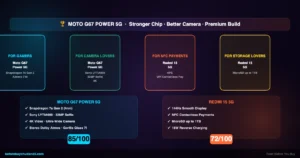
Here’s a quick summary of who won what:
Performance — Moto G67 Power 5G.
Camera — Moto G67 Power 5G.
Display brightness and glass — Moto G67 Power 5G.
Build quality — Moto G67 Power 5G.
Refresh rate — Redmi 15 5G.
NFC — Redmi 15 5G.
Expandable storage — Redmi 15 5G.
Reverse charging — Redmi 15 5G.
Headphone jack — Moto G67 Power 5G.
If you’re a gamer or heavy user, go with the Moto G67 Power 5G — the Snapdragon 7s Gen 2 and Adreno 710 GPU will serve you much better. If you’re a camera lover and post a lot of content, the 50MP Sony LYTIA600 sensor and 32MP selfie camera on the Moto are clear winners. If you’re a battery-first buyer, both are excellent — but the Redmi’s reverse charging gives it a tiny bonus. If you’re a budget-conscious buyer who needs NFC for payments and wants storage flexibility, the Redmi 15 5G is the more sensible pick.
Overall, in the Moto G67 Power 5G vs Redmi 15 5G, the Moto wins on most of the things that matter day-to-day. It’s the better all-rounder at this price. Check the latest price using the button below.
Explore More
Frequently Asked Questions
Which phone has a better processor — Moto G67 Power 5G or Redmi 15 5G?
Does the Redmi 15 5G support NFC for UPI payments?
Can I expand the storage on the Moto G67 Power 5G?
Which phone takes better selfies — Moto G67 Power 5G or Redmi 15 5G?
Is the Redmi 15 5G good for gaming?
Similar Mobile Phones to Consider
Alternatives in the same price range

Latest Mobile Phone Reviews
In-depth reviews based on specifications, research, and analysis

Oppo Find X9 Pro 5G Review: Best Flagship You Can Buy in India Right Now

OnePlus Nord CE5 Review: Is India’s Biggest Battery Phone Worth ₹26,999?
Redmi 15 5G Review: 7000mAh Battery Phone Under ₹16,000
POCO X7 Pro 5G Review: Complete Performance Analysis
Recently Added Comparisons
Latest comparisons added to our collection
Disclaimer: Prices and specifications shown may vary from actual products. Please check with the retailer before purchasing.
Was this helpful?
100% found this helpful
Thank you for your feedback!
User Comments
No comments yet. Be the first to share your thoughts!
Leave a Comment